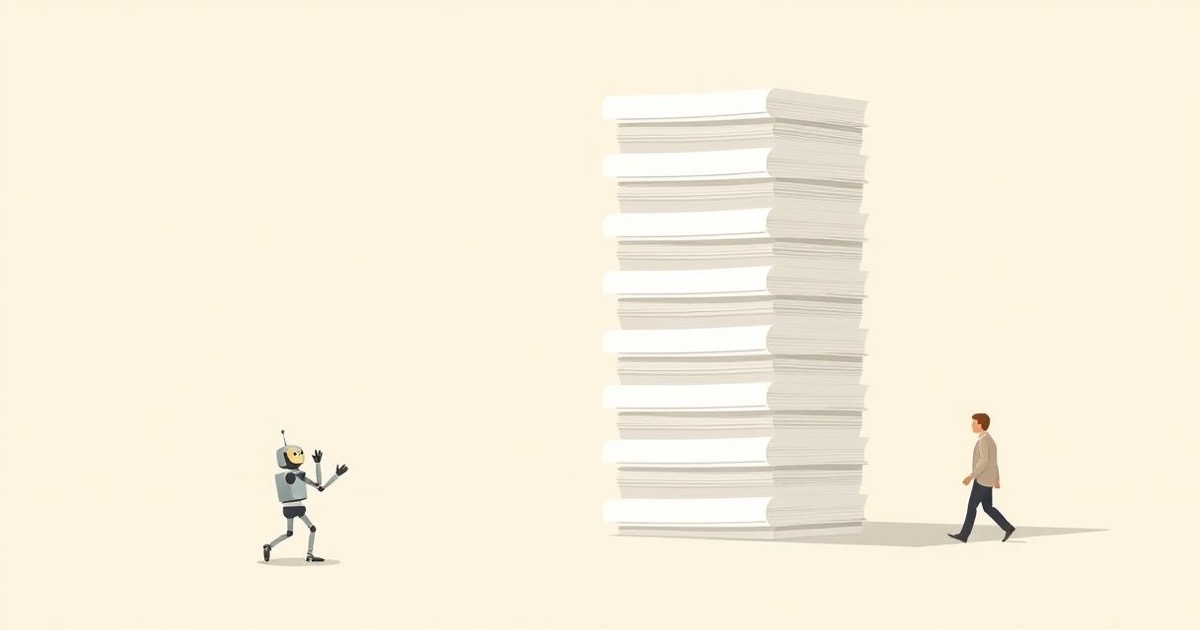
Somewhere in your company's Slack right now, a bot is posting a meeting summary. It is thorough. It is neatly formatted. It has bullet points, action items, and a section helpfully titled "Key Takeaways." And it will be read by exactly no one, joining the hundreds of other summaries stacked in that channel like unopened mail in a haunted house.
This is the strangest productivity story of 2026. AI meeting notes have gone fully mainstream — by most industry estimates, around three-quarters of knowledge workers now have meetings automatically transcribed and summarized, and analysts expect the AI note-taking market to grow from roughly $450 million in 2023 to $2.5 billion by 2033. We built machines to write down everything. Then we collectively agreed, without ever holding a meeting about it (thank goodness), to never read any of it.
The summary graveyard: how we got here
The math of a meeting transcript is brutal. A one-hour meeting produces roughly 8,000 to 10,000 words of transcript — about the length of two long magazine features, except the plot is your quarterly planning sync and every character talks over each other. Nobody was ever going to read that, which is why summarization felt like such an obvious win: compress the 10,000 words into 300, everyone stays informed, civilization advances.
Except that's not what happened. What happened is that every meeting now produces a summary, you attend six meetings a day (often with zero minutes between them), your team runs twenty more you skipped, and the bot dutifully summarizes all of them. The 10,000-word problem didn't go away — it became a 26-summaries-a-week problem. Industry watchers have started calling the pattern "adoption climbs, usage craters": leadership proudly tracks how many meetings the bot joins, and precisely nobody tracks whether a human ever opens the output.
We're using AI to summarize meetings nobody wanted to attend, producing summaries nobody wants to read.
Why your brain refuses to read them
It's tempting to blame laziness, but the psychology is more interesting than that. Unread summaries are a rational response to three real problems.
- They're addressed to no one. A summary blasted to a channel is like a group birthday card from the office — technically for you, emotionally for nobody. Research on diffusion of responsibility says the more people something is sent to, the less any individual feels obligated to act on it.
- They're accurate but not useful. AI recaps faithfully record that "the team discussed Q3 priorities and alignment was reached on next steps." Great. Which priorities? Whose steps? A summary can be 100% correct and still tell you nothing you'd act on — the corporate equivalent of a fortune cookie.
- They arrive after the moment that mattered. The decision you actually cared about happened live, in minute 34. By the time the recap lands, you were in two other meetings. Reading yesterday's summaries starts to feel like homework about the past — and your brain has already dumped 90% of the meeting anyway, so nothing in the recap has a memory to attach to.
There's also a quieter cost. When a bot attends and "handles the notes," people stop encoding the meeting themselves — why pay attention when the machine is paying attention for you? Psychologists call the pattern cognitive offloading, and it means the summary graveyard doesn't just waste the bot's effort. It erodes the one thing meetings were supposed to produce: a shared memory of what was decided.
The graveyard has a second problem: everyone's buried in it
The broadcast model has a privacy tax, too. When the bot summarizes for everyone, everything you said gets processed on someone's cloud, stored in someone's channel, and searchable by people who weren't in the room. About a third of meetings now have an AI notetaker present, and most attendees were never actually asked. So the current equilibrium is: your words are permanently recorded, uploaded, and distributed — in service of a document nobody reads. It's the worst trade in office history. We gave up privacy for a PDF that dies in a channel.
What actually works: notes with an owner
Here's the twist: the research on note-taking hasn't changed. Notes work when they belong to someone — when the person who needs the information captures it for their own future use. The consultants who see real returns from AI meeting notes all land on the same principle: a summary is useful precisely to the degree that a specific person asked for it, owns it, and will act on it. The fix isn't better summarization. It's better ownership.
- Summaries should be pulled, not pushed. You reading your own recap before a follow-up beats forty people ignoring a broadcast.
- Action items should leave the summary immediately — into your task list, your calendar, your CRM. A to-do living in a channel post is a to-do in witness protection.
- The notes should be yours. Your questions, your commitments, your client's exact words — not a neutral transcript of everyone addressed to everyone.
Meeting notes for an audience of one: you
Meetly flips the broadcast model. It records and transcribes on your iPhone — no bot in the call, no cloud upload, no channel spam. You get your own private summary and action items seconds after the meeting ends, on the device in your pocket. Notes with exactly one owner, which is why they actually get read.
Download MeetlyA 30-second system for summaries you'll actually use
If you change nothing else, adopt this: right after a meeting that mattered, spend 30 seconds with your own summary and answer two questions. What did I commit to? and What did someone else commit to me? Move both answers out of the notes and into wherever you track work. That's it. This tiny ritual beats the entire broadcast-summary industrial complex, because it converts information into obligations while the meeting is still warm in your memory.
And for the meetings that didn't matter? Let them go unsummarized. Not every conversation needs a tombstone. The goal was never to archive human speech at industrial scale — it was to stop forgetting the things we promised each other. That takes one good recording, one honest summary, and one person who reads it: the one it was for.
Try the audience-of-one approach
Download Meetly free on iPhone. Record your next meeting, get a private on-device summary with your action items, and see how different notes feel when they're written for you — not for a channel nobody checks.
Download MeetlyFrequently asked questions
Why does nobody read AI meeting summaries?
Three main reasons: broadcast summaries are addressed to everyone and therefore owned by no one (diffusion of responsibility); AI recaps are often accurate but too generic to act on; and they arrive after the moment of relevance has passed. Summaries get read when a specific person requested them for their own use — ownership, not quality, is the deciding factor.
Are AI meeting notes still worth using in 2026?
Yes — but as a personal tool, not a broadcast system. A private summary you review for 30 seconds after each meeting, pulling out your commitments and others' promises to you, reliably saves time. Auto-posting every meeting's recap to a shared channel mostly produces an archive nobody opens.
How many words is a one-hour meeting transcript?
Roughly 8,000 to 10,000 words, based on average speaking rates of 130–160 words per minute. That's about the length of two long-form magazine articles per meeting, which is why raw transcripts go unread and even summaries pile up faster than people can process them.
What is cognitive offloading in meetings?
Cognitive offloading is when you delegate remembering to an external tool and, as a result, encode less yourself. When a bot 'handles the notes,' attendees tend to pay shallower attention. The fix is to keep a lightweight personal review step — skim your summary and extract your action items — so the tool supports memory instead of replacing it.
How do I get AI meeting notes without adding a bot to the call?
Use an on-device recorder app on your phone instead of a meeting bot. Apps like Meetly record and transcribe locally on the iPhone, so there's no bot participant in the call, nothing uploaded to a cloud, and no auto-posted channel summary — you get a private transcript and summary that only you see. Always follow your local recording-consent rules and let participants know you're taking notes.