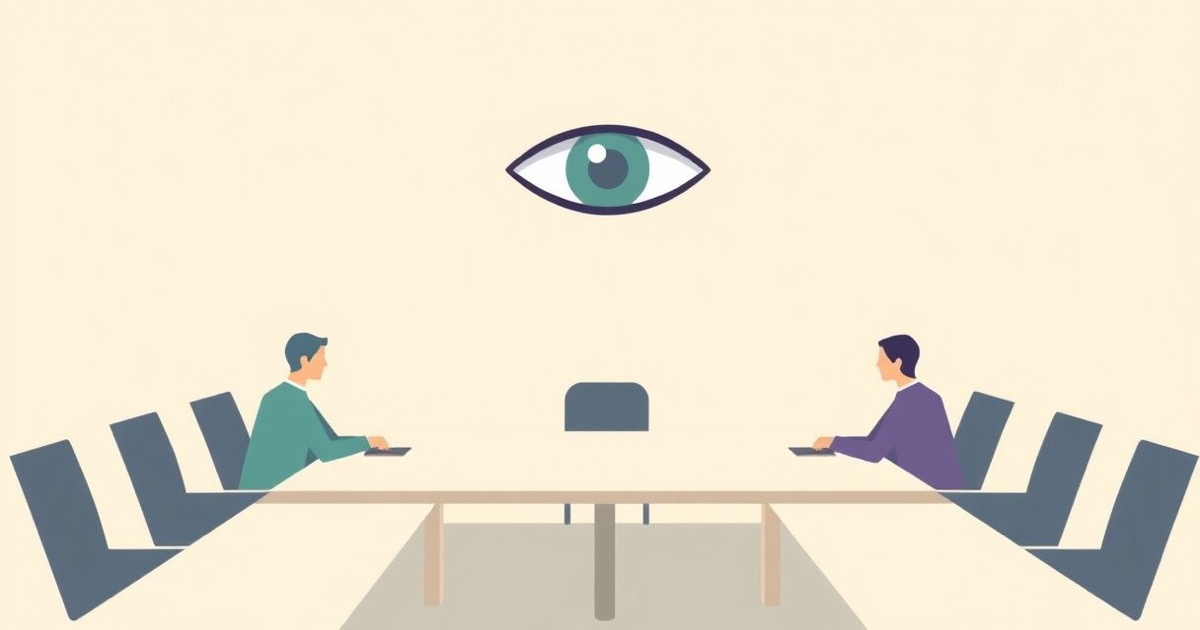
The standard advice in 2026 is that an AI notetaker is free productivity: invite the bot, stay present in the conversation, get a tidy summary afterwards. By some industry counts, roughly three in four professional meetings now have one running. The pitch treats the notetaker as furniture — a neutral scribe in the corner that changes nothing except how much typing you do.
That pitch is wrong. A notetaker is not furniture. It is the single most influential participant in the room — not because of what it says, but because of what everyone else stops saying, starts saying, or says differently the moment they know a permanent record is being made. Physicists call this an observer effect: the act of measuring a system changes the system. Your meetings are not exempt.
The evidence: recording rewires who talks
The most direct data comes from Read AI, which analyzed anonymized patterns across 159,870 recorded virtual and hybrid meetings over 60 days, working with organizational behavior researcher Rebecca Hinds. Two findings stand out. First, in recorded meetings, individual contributors spoke almost as much as managers — the usual seniority gradient in airtime flattened. Second, women participated about 9% more than men when an AI notetaker was present.
The researchers' explanation is telling: when people know their words are being captured, summarized, and possibly revisited, they become more deliberate — about what they say, and about how much space they take up. Men interrupted less. People who usually dominate got more self-aware. And because women are disproportionately volunteered into the role of human notetaker, handing that job to software freed them to actually join the conversation they were previously transcribing.
If that were the whole story, the case would be closed: record everything, get flatter, fairer meetings. But the same mechanism that makes the loud more careful makes the honest more careful too — and that's where the sales pitch falls apart.
The same effect, pointed the other way
In February 2026, Fortune reported that AI notetakers were "creating HR nightmares": bots that stayed on the call after the humans meant to leave, dutifully transcribed the candid gossip that followed, and then emailed the transcript to the full invite list. Employment lawyers described a new genre of workplace dispute built entirely on AI-generated meeting records — including summaries that flagged jokes, venting, and half-formed ideas as if they were considered positions.
By July, the Associated Press was reporting that professionals had begun quietly questioning the tools they'd adopted a year earlier — not because the transcripts were inaccurate, but because meetings had started to feel like depositions. People report withholding rough ideas, softening dissent, and saving real talk for the hallway afterwards. Labor lawyers have raised a sharper version of the problem: cloud transcription tools capturing legally protected conversations, like union organizing, and archiving them on the employer's servers.
Here's the contrarian core of it: the observer effect isn't a bug you can patch with etiquette. It's the product working as designed. A tool built to make every word retrievable will, by definition, make people speak as if every word may be retrieved. You cannot have a meeting that is simultaneously fully archived, widely distributed, and fully candid. Something gives — and it's usually candor.
Why "people will get used to it" is cope
The optimistic take is that recording anxiety is transitional, like camera shyness in 2020. The psychology says otherwise. Decades of research on psychological safety — most famously Google's Project Aristotle — found that the strongest predictor of team performance is whether people feel safe saying risky, half-baked, or dissenting things. Brainstorms, retros, and post-mortems only work when the cost of being wrong out loud is near zero. A permanent, searchable, forwardable record raises that cost and keeps it raised. Habituation doesn't remove the incentive; it just teaches people to perform more smoothly.
So the honest question isn't "should meetings be recorded?" — for plenty of meetings, a record is genuinely valuable, and human memory is demonstrably terrible at retaining what was decided. The honest question is: who is the record for, and where does it live?
The variable everyone ignores: where the record goes
Lump every "AI notetaker" together and the debate goes nowhere. Separate them by what happens to the recording, and the observer effect splits into two very different animals:
- A visible bot with cloud distribution. A third-party participant joins the call, audio is uploaded to a vendor's servers, and the summary is auto-emailed to the invite list — sometimes to people who left early, sometimes with the vendor training on the data. This maximizes the chilling effect: everyone is performing for an audience they can't see, indefinitely.
- A private, on-device record. One person captures the meeting for their own recall — the modern equivalent of taking excellent personal notes. Nothing is uploaded, nothing is auto-distributed, and the blast radius of a candid moment stays exactly where it always was: in the room.
- The middle cases. Team-visible transcripts with short retention, or recordings only for meetings with external stakes (client calls, negotiations, interviews) where everyone expects formality anyway.
The Read AI data and the Fortune horror stories are both about category one — the bot in the room, wired to an archive other people control. Category two barely triggers the performance problem, because the social contract is the same as a colleague with a good notebook: they remember what was said, and what they do with it is governed by ordinary professional trust, not a vendor's retention policy. Consent still matters — asking before you record is both legally safer and basic respect — but consent to a private memory aid is a much easier conversation than consent to a cloud archive.
Keep the record. Skip the bot.
Meetly records and transcribes meetings entirely on your iPhone — no bot joining the call, no cloud upload, no auto-emailed transcript. You get the perfect recall; the room keeps its candor. Free to start.
Download MeetlyA sane recording protocol
If you run meetings, you can capture most of the value of AI notes while dodging most of the observer-effect damage. A few rules that hold up:
- Match the tool to the meeting. Decisions, client calls, interviews, and anything with commitments deserve a record. Brainstorms, retros, and sensitive 1:1s mostly don't — or deserve one that stays private to the note-taker. If it's a meeting where you want bad ideas out loud, don't archive them.
- Ask, every time. One sentence at the start — "I'm recording this for my own notes, all right?" — handles etiquette and, in many places, the law. Consent norms differ by country and by context; when in doubt, ask.
- Keep distribution manual. Auto-emailing summaries to the full invite list is how venting becomes evidence. A human should decide what's worth sharing, and share the decisions and action items — not the transcript.
- Prefer on-device capture for anything sensitive. If the audio never leaves your phone, there is no vendor archive to subpoena, breach, or train on. For legal, medical, and HR-adjacent conversations this isn't a nice-to-have; it's the whole game.
- Kill the bot's ghost. If you do use a cloud bot, learn how it behaves when people leave, and end its session explicitly. The post-meeting chat is where the HR nightmares live.
Use the observer effect on purpose
None of this means the behavioral shift is all downside. The flattening effect is real and useful: if your meetings are dominated by the same two voices, announcing a recorded, transcribed session for decision-heavy meetings is one of the cheapest interventions available — the airtime data shows it works. The skill is deploying it deliberately, the way you'd deploy a formal agenda: for the meetings that need discipline, not the ones that need honesty.
The tools aren't going away, and they shouldn't — badly used AI summaries are a separate problem from a well-kept record, and a good record beats a bad memory every time. But stop calling the notetaker neutral. It's an intervention in your team's psychology. Choose the version whose side effects you actually want: a private memory that makes you sharper, not a surveillance layer that makes everyone else quieter.
Meetings worth remembering, without the audience
Meetly turns meetings into transcripts, summaries, and action items — processed locally with WhisperKit in 90+ languages, stored only on your device. No bot in the room, no server in the loop.
Download MeetlyFrequently asked questions
Do AI notetakers change how people behave in meetings?
Yes, measurably. An analysis of 159,870 recorded meetings by Read AI found that when an AI notetaker is present, individual contributors speak almost as much as managers and women participate about 9% more than men. Reporting from Fortune and the AP documents the flip side: people self-censor, soften dissent, and save candid conversation for after the recording stops.
What is the observer effect in meetings?
It's the phenomenon where recording or measuring a conversation changes the conversation itself. When participants know their words are captured and may be revisited, they become more deliberate — which can mean fairer airtime and fewer interruptions, but also less honesty, fewer half-formed ideas, and more performing for the transcript.
Should I stop using an AI notetaker?
Not necessarily — you should match it to the meeting. Records are valuable for decisions, client calls, and interviews. They're actively harmful in brainstorms, retros, and sensitive 1:1s, where psychological safety matters more than recall. The biggest single improvement is switching from a cloud bot that auto-distributes transcripts to a private, on-device recording that only you control.
Are on-device meeting recorders better for privacy than AI meeting bots?
Structurally, yes. A cloud bot uploads audio to a vendor's servers, where it's subject to the vendor's retention, training, and breach exposure, and summaries are often auto-shared. An on-device recorder like Meetly processes audio locally on your phone — there's no third-party archive, so the recording carries the same privacy profile as personal notes. You still need participants' consent where the law or basic courtesy requires it.
Is it legal for an AI notetaker to keep recording after people leave a meeting?
It depends on jurisdiction and consent, but it's a real legal risk — employment lawyers have flagged cases where bots transcribed post-meeting chatter and distributed it, and cloud tools that capture legally protected conversations (like union organizing in the US) can create liability for employers. Practically: end the bot's session explicitly, and never let summaries auto-send.