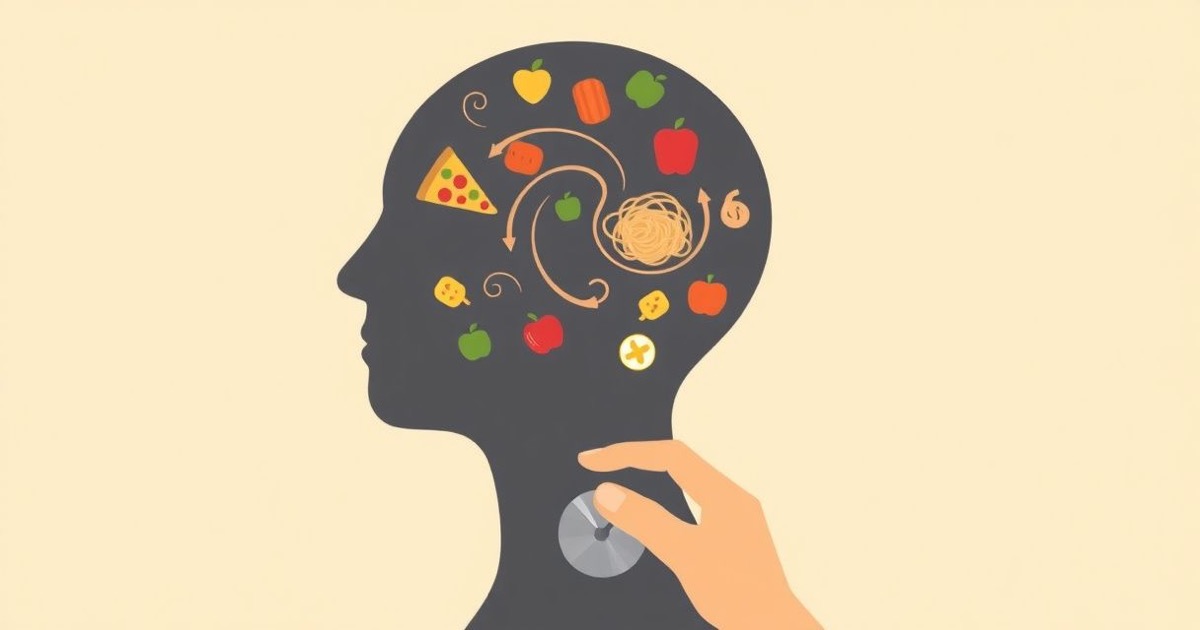
It's 2:47 on a Tuesday afternoon and you are, technically, in a budget review. But a separate meeting has been running in your head since lunch. The leftover pad thai in the office fridge has the floor. The vending machine on level three would like to add something. A voice that sounds suspiciously like your own is asking, for the fourth time this hour, what's for dinner — even though you're not hungry, you just ate, and you genuinely want to think about literally anything else.
For decades, people who lived with that internal broadcast assumed it was a personal failing — greed, weak discipline, "being obsessed with food." Then, around 2023, a name for it went viral: food noise. And in the three years since, something unusual happened. The internet slang became a research subject. Scientists built a way to measure it, ran controlled studies on it, and confirmed what sufferers always knew: it's real, it varies enormously between people, and it has surprisingly little to do with willpower.
From TikTok phrase to measurable phenomenon
Researchers now define food noise as persistent, intrusive thoughts about food that are disruptive to daily life and make healthy behaviors harder. The key word is intrusive: this isn't enjoying the anticipation of a good dinner. It's food-related thought that shows up uninvited, when you're not physically hungry, and keeps pulling attention away from whatever you're actually doing.
The turning point was the GLP-1 era. When people on medications like semaglutide kept reporting — unprompted, in study after study — that "the food chatter just stopped," researchers needed a way to quantify what had stopped. The result was the validated Food Noise Questionnaire (FNQ), and with it, real numbers. In research presented at the European Congress on Obesity in 2026, participants combining a GLP-1 medication with a behavioral program dropped their food-noise scores roughly three and a half times more than those on the behavioral program alone. The share who said they spent too much time thinking about food fell from 63% to 15%. Reports of uncontrollable food thoughts fell from 53% to 15%.
Those numbers matter beyond pharmacology, because they settle an old argument. If food noise were a character flaw, a receptor agonist couldn't switch it off. The fact that it can tells you the volume knob is biological — hormones like ghrelin and leptin, blood sugar swings, and reward circuitry in the brain that evolved for scarcity and now lives next to a delivery app.
The dieter's paradox: restriction turns the volume up
Here's the cruelest part, and science has known it since the 1940s. In the famous Minnesota Starvation Experiment, Ancel Keys put healthy young men on a prolonged semi-starvation diet. The physical effects were expected. The mental ones were startling: the men became consumed by food. They collected recipes, read cookbooks at night, daydreamed about meals, talked about little else. Several planned careers in food. These were men with no history of food obsession — the deprivation itself manufactured it.
The same mechanism operates, in miniature, every time you crash-diet. Cut intake too hard and your body responds like it's 1944: hunger hormones rise, and your brain helpfully promotes food to the top of every mental feed. This is why white-knuckle dieting so often ends in a face-first landing at 9pm — the noise wins because biology is louder than resolve. If your eating plan requires ignoring a constant internal broadcast, the plan is fighting your own neurochemistry, and your neurochemistry has better stamina.
What turns the volume down (without a prescription)
GLP-1 medications are a legitimate tool, and for some people the right one — that conversation belongs with a doctor. But the same research literature points to a set of non-pharmacological levers that reliably lower the volume. None of them is dramatic. Together, they compound:
- Eat enough, on a schedule. Regular meals with real protein and fiber (a common evidence-based floor: about 0.75 g of protein per kg of body weight daily and around 30 g of fiber) blunt the blood-sugar swings and ghrelin spikes that generate spontaneous food thoughts. Skipped meals are food-noise generators with a delay timer.
- Guard your sleep. Short sleep measurably raises ghrelin, lowers leptin, and makes high-calorie food more rewarding to the brain. One bad night can make Wednesday's food noise genuinely louder — it isn't your imagination.
- Engineer the environment. Intrusive thoughts need cues. Snacks on the counter, food content in your feeds, the delivery app on your home screen — each is a microphone for the noise. Moving temptation out of sight is unglamorous and works.
- Surf the urge instead of arguing with it. Mindfulness techniques like urge surfing don't erase cravings; they insert a few seconds of space between thought and action. Cravings crest and fall like waves — most pass within minutes if you don't feed them attention.
- Stop the crash diet. A modest, sustainable deficit keeps the Minnesota effect asleep. The more brutal the restriction, the louder the rebound broadcast.
The tracking trap: when the cure feeds the disease
There's one more lever, and it's the awkward one for a nutrition blog to bring up: how you track matters, because tracking itself can become food noise. Self-monitoring is one of the best-evidenced behavior-change tools in nutrition science — people who log what they eat consistently outperform people who don't. But the classic implementation is a database app that has you searching, scanning, weighing, and scrolling through food entries five times a day. For someone whose problem is thinking about food too much, spending twenty extra minutes a day inside a food database is pouring gasoline on the fire. It's a big part of why people abandon tracking apps within weeks.
The fix isn't to stop tracking — it's to shrink the interaction until it can't feed the loop. Say what you ate, once, out loud, and be done. Logging becomes a five-second close-the-loop ritual instead of a browsing session: the meal is recorded, the decision is externalized, and your brain gets permission to drop the thread. People who struggle with food noise often find that the act of capturing the thought — like writing down a worry — is itself what quiets it.
Track in five seconds, then stop thinking about it
VoiceLog turns one spoken sentence — "chicken rice bowl and an iced latte" — into a logged meal with calories and macros, transcribed on-device. No database spelunking, no barcode hunts, no twenty minutes a day inside a food app. Close the loop and get on with your afternoon.
Get VoiceLogA realistic quieting protocol
Put together, a week of turning the volume down looks like this: three real meals a day anchored by protein, a fiber source you don't hate, a bedtime you mostly keep, the snacks off the counter, and a five-second log after each meal so the food thought has somewhere to go besides around your head. Not a single heroic intervention — a set of small ones aimed at the actual mechanism.
And calibrate your expectations to the science: even the medication studies didn't report silence. They reported thoughts dropping from uncontrollable to background — from 63% of people saying food thoughts ate their day down to 15%. That's the honest goal. Some signal about food is healthy; it's how your body orders lunch. The win isn't a silent mind. It's a mind where you're the one holding the volume dial — and where a Tuesday budget review is just a budget review, with no pad thai on the agenda.
The lowest-friction food log there is
Meals, workouts, and more — logged by voice in one sentence, on-device. VoiceLog keeps the record so your brain doesn't have to keep the broadcast. Free to start.
Get VoiceLogFrequently asked questions
What is food noise?
Food noise is the research term for persistent, intrusive thoughts about food — a running internal commentary that shows up when you're not physically hungry and interferes with daily life. It's now formally measured with the validated Food Noise Questionnaire (FNQ), and studies link it to hunger hormones, blood-sugar swings, and the brain's reward circuitry rather than to willpower.
How do I stop food noise without Ozempic or other GLP-1 drugs?
The best-evidenced non-medication levers: eat regular meals with adequate protein (about 0.75 g/kg per day as a floor) and roughly 30 g of fiber to stabilize blood sugar; protect your sleep, since sleep debt raises ghrelin and makes calorie-dense food more rewarding; remove visual food cues from your environment; use urge-surfing to let cravings pass instead of fighting them; and avoid aggressive crash diets, which reliably amplify food thoughts.
Does dieting make food noise worse?
Severe restriction does. The Minnesota Starvation Experiment showed that prolonged heavy caloric restriction made previously normal eaters obsessed with food — collecting recipes, dreaming about meals. Modern crash diets trigger a milder version of the same response: hunger hormones rise and the brain pushes food thoughts to the front. A modest, sustainable deficit keeps that rebound effect largely dormant.
Do GLP-1 medications really quiet food noise?
Studies say yes, substantially. In 2026 research using the Food Noise Questionnaire, people combining a GLP-1 with a behavioral program cut food-noise scores about 3.5× more than behavioral therapy alone; the share reporting they spent too much time thinking about food dropped from 63% to 15%. Whether medication is appropriate is a conversation for your doctor — the same studies show behavioral changes help too, just more slowly.
Can calorie tracking make food noise worse?
It can, if tracking means long sessions inside a food database — searching entries, scanning barcodes, and scrolling food lists gives intrusive food thoughts more screen time, not less. Low-friction methods avoid this: logging a meal in one spoken sentence takes seconds, externalizes the decision, and — like writing down a worry — often quiets the thought instead of feeding it.