First, Credit Where It's Due
MyFitnessPal earned its position. Its food database is enormous — millions of entries covering packaged foods, restaurant chains, and user submissions — and for barcode-scannable packaged food it's hard to beat. It has years of refinement, a large community, recipes, and integrations with most fitness platforms. If you eat mostly packaged and chain-restaurant food and enjoy the ritual of precise logging, MFP works.
So why do so many people search for a MyFitnessPal alternative? Usually not because of what MFP can do, but because of what it demands.
The Burnout Pattern
Calorie-tracking burnout follows a predictable arc:
- Week 1: You log everything. Searching the database feels like diligence.
- Week 2–3: Home-cooked meals become a chore — six ingredient searches for one stir-fry. You start picking "close enough" entries.
- Week 4+: You skip a dinner, then a day. The unlogged backlog feels like debt. Opening the app now comes with guilt attached.
- The quiet quit: The streak breaks and the app moves to the second home screen.
The core issue is that database logging front-loads effort onto every single meal. The database's size doesn't help when your dinner is "whatever was in the fridge, sauteed" — you either build the recipe entry by entry or you guess anyway. At that point you're doing manual work to get an estimate.
The Voice-First Alternative
VoiceLog takes the opposite bet: instead of maximizing precision per entry, it minimizes the cost of entering. You tap the mic and say what you ate — "chicken stir-fry with rice and a glass of orange juice" — and the app estimates calories, protein, carbs, and fat from the description. Logging a meal takes about five seconds, whether it's a branded protein bar or your grandmother's curry.
That single design choice dissolves the burnout arc. There's no search, no serving-size dropdown, and no penalty for home cooking. Mixed meals — MFP's worst case — are voice logging's easiest case, because you just describe the plate. We go deeper on the mechanics in our voice calorie tracking guide.
Honest Comparison: MyFitnessPal vs. VoiceLog
| Dimension | MyFitnessPal | VoiceLog |
|---|---|---|
| Food database size | ✅ Millions of entries — the clear winner | No database — AI estimates from your description |
| Time to log a meal | 1–3 minutes of searching and taps | ✅ ~5 seconds, spoken |
| Packaged food precision | ✅ Exact via barcode/label entries | Estimate (editable) |
| Home-cooked / mixed meals | Tedious — per-ingredient entry | ✅ Describe the plate in one sentence |
| Beyond food | Exercise logging | ✅ Workouts, expenses, to-dos, journal — same sentence |
| Privacy model | Cloud account; ad-supported free tier | ✅ On-device transcription; sync is opt-in |
| Platforms | ✅ iOS, Android, web | iOS only (iOS 18+) |
| Premium price | Premium tiers (pricing varies by plan) | Pro $12.99/mo or $99.99/yr, 7-day trial |
Read the table honestly and the pattern is clear: MyFitnessPal wins on database depth, platform coverage, and label-exact precision. VoiceLog wins on speed, friction, privacy, and breadth of what one log can capture. Neither is universally better — they optimize for different users.
CICO Doesn't Require Perfect Numbers
If you're running CICO (calories in, calories out), your lever is the gap between intake and expenditure over weeks — not the third decimal of any single meal. Food labels themselves are legally allowed meaningful error margins, database entries are frequently user-submitted and wrong, and portion estimation is the dominant source of error in every method. Precision theater doesn't change outcomes; consistent logging does.
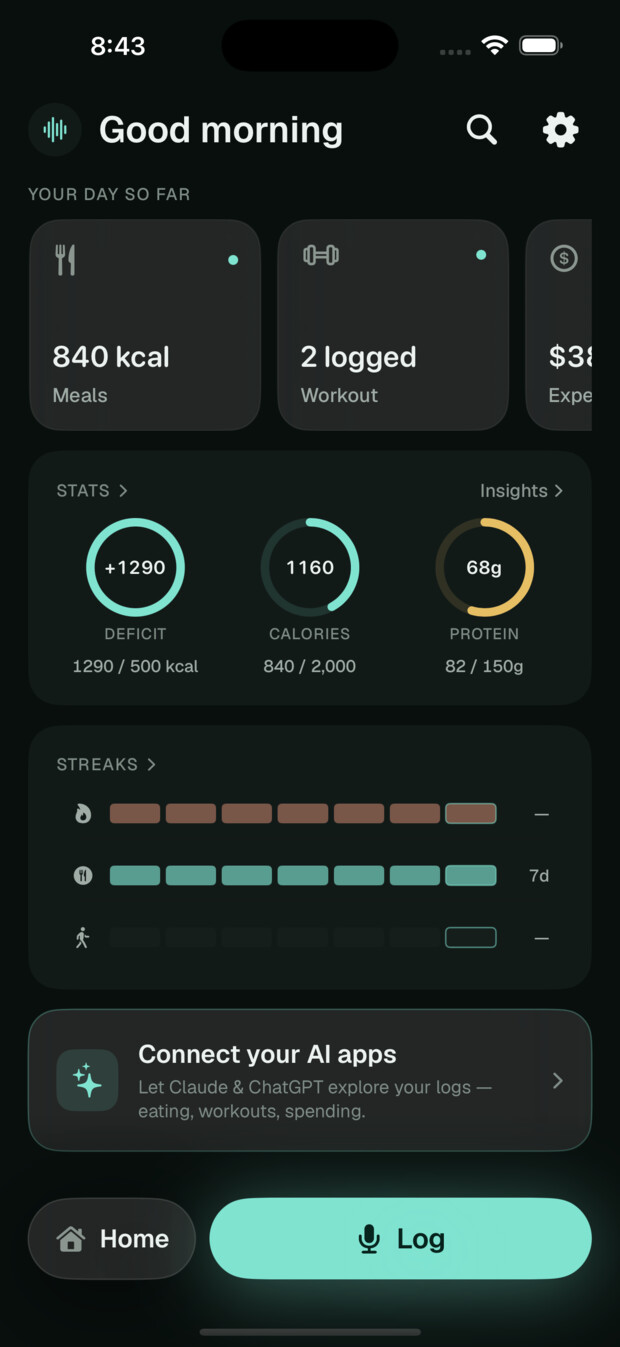
That's the argument for the easiest calorie tracker you'll actually keep using: a five-second estimate logged every day gives you a truer weekly picture than exact entries logged four days out of seven. VoiceLog's Home snapshot — calories, deficit, protein, steps — is built around exactly that weekly-trend mindset. For protein-focused eaters, the macro tracking guide covers how targets work.
Who Should Stick With MyFitnessPal
- You eat mostly barcoded, packaged foods and want label-exact numbers
- You're on Android or need web access
- You rely on its recipe builder or community features
- You're in a phase (contest prep, medical protocol) where gram-level precision genuinely matters
Who Should Try Voice Logging
- You've started and abandoned database tracking more than once
- You cook at home or eat mixed meals that don't match database entries
- You want one place for food, workouts, and spending instead of three apps
- You care that your health data stays on your device by default
- You'd rather have a good estimate every day than a perfect number sometimes
Honest Limitations
To be fair to both sides: VoiceLog's numbers are AI estimates, not label lookups — a branded cereal logged by voice will be close, but MFP's barcode scan will be exact. There's no food database to browse and no barcode scanner. VoiceLog is English-first today and available only on iPhone (iOS 18+), while MFP covers Android and web. And if your routine is built around MFP's recipes or community, you'd be giving those up. The switch makes sense when friction, not precision, is what's breaking your tracking.
Frequently Asked Questions
Is VoiceLog a full MyFitnessPal replacement?
For calorie and macro tracking, yes — you log by voice instead of database search, and daily totals, targets, and streaks are all there. It doesn't replicate MFP's database browsing, barcode scanning, or community features.
How accurate are voice estimates compared to database entries?
For typical meals, estimates land in the same range as database logging once you account for portion-size guessing — which affects every method. Packaged foods with labels are the one case where a database is strictly more precise. Every VoiceLog entry is editable.
Can I import my MyFitnessPal history?
No, there's no direct import today. Most switchers simply start fresh — daily targets and streaks rebuild quickly, and the point of the switch is the go-forward habit.
Does VoiceLog work for CICO weight loss?
Yes — set your targets and the Home screen shows calories eaten and your running deficit each day, alongside protein and steps. The estimate-based approach fits CICO well because weekly trends drive results.
What does VoiceLog cost?
Voice logging with calorie and macro estimates is free. VoiceLog Pro is $12.99/month or $99.99/year with a 7-day free trial, adding meal-photo and receipt scanning, AI assistant connections, longer recordings, and sync.
The Bottom Line
If MyFitnessPal works for you, keep it — it's a capable tool with an unmatched database. But if you've burned out on it more than once, the problem probably isn't you. It's the cost of every log. Switching to a five-second spoken sentence is the single biggest friction cut available in calorie tracking today.