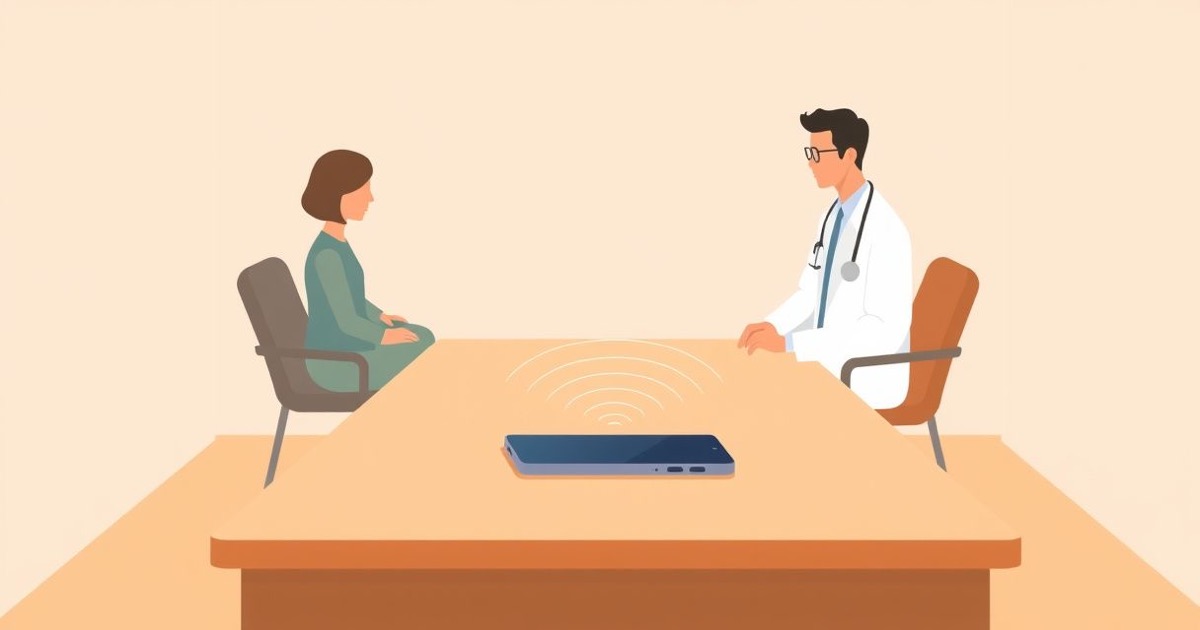
You waited three weeks for the appointment, sat twenty minutes in the waiting room, and got eleven minutes with the doctor. In those eleven minutes: a diagnosis you'd never heard of, a medication change, two tests to schedule, and something about what to do if the symptoms get worse. By the time you reach the parking lot, you can reliably reproduce about three of those things — and one of them incorrectly.
That's not an insult to your memory. It's one of the most consistently replicated findings in health communication research. A landmark review in the Journal of the Royal Society of Medicine by Roy Kessels put numbers on it: patients immediately forget 40–80% of the medical information a clinician gives them, and of what they do retain, almost half is remembered incorrectly. The more information delivered, the smaller the fraction that survives. Which raises an obvious question that more and more patients are quietly asking: why am I not just recording this?
Why your brain fails you in the exam room
Medical appointments are close to a worst-case scenario for human memory. Encoding — the process of getting information into memory in the first place — degrades sharply under stress, and few conversations are more stressful than one about your own body. Researchers sometimes describe the effect of anxiety on clinical recall as attention narrowing: when a doctor says a frightening word — biopsy, abnormal, chronic — your mind stays on that word while the doctor keeps talking. The crucial instructions that follow a diagnosis often land on a brain that is, functionally, not listening.
The details of the setting make it worse. Information arrives dense and jargon-heavy, exactly once, with no rewind. Visits are short and getting shorter. Many patients are older — and age-related memory decline hits exactly the population managing the most medications and instructions. And unlike a work meeting, you can't ping a colleague afterward to ask what was decided. The stakes are also higher: misremembered medical instructions aren't a missed deadline, they're a wrong dose. We've written before about why people forget most of what happens in meetings; a medical consultation is that same forgetting curve with adrenaline poured on it.
Patients have always improvised countermeasures — bringing a spouse, scribbling on the back of the visit summary, asking the doctor to repeat things. All of them help. But there's now a country's worth of evidence about a more direct fix, because researchers have been studying consultation recording for over four decades, mostly in oncology, where the forget-everything problem is most acute.
What the research says recording actually does
The Dartmouth Institute's Glyn Elwyn, one of the leading researchers on this question, has been blunt about the direction of the evidence: patients who receive recordings of their consultations listen to them again — often several times — share them with family members who couldn't attend, understand their condition better, and report greater satisfaction with their care. Reviews of consultation-recording trials in cancer care found that most patients who were given a recording replayed it at least once and the majority rated it as genuinely useful for understanding their diagnosis and treatment options.
Three of those benefits deserve unpacking. First, re-listening beats remembering. A recording converts an unrepeatable eleven minutes into a document you can return to when the adrenaline is gone — which is when comprehension actually happens. Second, recordings solve the absent-caregiver problem. A huge share of healthcare decisions involve someone who wasn't in the room: the adult daughter managing her father's cardiology from another city, the spouse at work during the appointment. Playing them the actual conversation beats a stressed secondhand summary every time. Third, and least appreciated: knowing it's captured changes the visit itself. Patients who aren't frantically trying to memorize dosages are free to do the thing that improves outcomes most — ask questions.
Is it legal? Almost certainly — but the details matter
In the United States, recording law is state law, and it splits into two regimes. In 39 states plus DC, one-party consent applies: any participant in a conversation may record it, and since you're obviously a participant in your own appointment, you may legally record — even, strictly speaking, without asking. Eleven states require all-party consent: California, Florida, Illinois, Maryland, Massachusetts, Michigan, Montana, New Hampshire, Oregon, Pennsylvania, and Washington. There, recording without your doctor's agreement isn't just rude — it can be a crime.
Now the myth that needs killing: HIPAA does not prohibit you from recording your own appointment. HIPAA regulates how covered entities — providers, insurers, their business associates — handle your health information. It places no restrictions on what a patient does with information about their own care. A clinic can have a policy asking patients not to record on its premises, but that's an institutional rule, not federal privacy law, and it cannot retroactively make a lawful recording illegal. If a front-desk sign cites HIPAA to forbid patient recordings, the sign is wrong about why.
Why doctors hesitate — and why most say yes anyway
Physicians' anxiety about patient recordings is real and specific: it's about lawsuits. In one survey of medical providers, 63% said fear of legal liability made them hesitate to consent to being recorded. Malpractice insurers publish whole advisories on the topic. Some doctors also worry that clips could end up on social media, stripped of context, or that a recorder in the room will make them practice defensively — speaking for the transcript instead of the patient.
Here's what's changed in the last decade: the profession's center of gravity has shifted from resistance to managed acceptance. Medical associations now generally advise physicians to assume they might be recorded and to respond to open requests with a conversation, not a refusal. Elwyn's group and others have pointed out the uncomfortable flip side of secrecy: surveys suggest a meaningful minority of patients — on the order of one in seven or eight in some studies — have covertly recorded a visit, precisely because they feared asking. Doctors who welcome open recording largely eliminate covert recording, get the liability clarity of knowing a recording exists, and — per the same research — see the recording function mostly as what it is: a memory aid, not a deposition. The dynamics are the same ones we mapped for AI notetakers in work meetings: transparency converts a threat into a tool.
So ask. A version that almost always gets a yes: "I have trouble remembering everything after appointments — do you mind if I record the audio so I can re-listen at home? It's just for me and my family." It names the purpose, names the boundary, and gives the doctor the thing the liability research says they need: knowledge that the recording exists and clarity about what it's for.
The part nobody thinks about: where does the recording go?
Here's the irony in how most people would record a doctor's visit in 2026: they'd worry for a week about whether it's legal and polite, get the doctor's blessing — and then pipe the most sensitive conversation they have all year through a cloud transcription service. A recording of a medical appointment contains your diagnoses, your medications, your prognosis, your voice, and your doctor's. Upload it to a typical AI transcription app and it lands on servers governed by terms of service, not by medical ethics — retained for unclear periods, sometimes eligible for model training, breachable like anything else online. HIPAA, remember, binds your provider — it does nothing about what an app company does with the audio you hand it.
Record the visit. Keep it as private as the exam room.
Meetly records, transcribes, and summarizes entirely on your iPhone — the audio never touches a cloud server, so a conversation about your health stays between you, your doctor, and your phone. You get a searchable transcript and a summary you can replay for a spouse or caregiver, in 90+ languages, with no account and no uploads. It's the memory aid the research recommends, minus the server farm.
Download MeetlyHow to record an appointment well: a short protocol
- Ask at the start, every time. Even in one-party states, even with a doctor who agreed last visit. It takes ten seconds and keeps the relationship clean.
- Phone face-down on the desk or your knee, mics uncovered. You'll capture both voices clearly in a small exam room. Then stop thinking about it — the point is to free your attention, not split it.
- Bring your questions written down. Recording fixes the output side of the visit; a question list fixes the input side. The combination is what actually changes outcomes.
- Re-listen within a day — with a pen, or with the transcript. Pull out the concrete items: medication names and doses, what each test is for, red-flag symptoms, next appointments. This is when the 40–80% comes back.
- Share deliberately, store carefully. Play it for the family member who needed to hear it. Don't post it, don't group-chat it — a recording that includes your doctor's voice deserves the same discretion you're asking of them.
When not to record
A few honest boundaries. If your doctor says no, respect it and use the old tools — bring a companion, take notes, ask for the after-visit summary — rather than recording covertly; a secret recording in an all-party-consent state is illegal, and even where legal it poisons the relationship that your care depends on. Skip recording in group settings like therapy groups or family conferences unless everyone agrees. And if your motive has quietly shifted from remembering to building a case, notice that — a patient-doctor relationship running on litigation footing usually needs a different fix, like a second opinion or a new doctor. Clinicians themselves face a stricter version of the same privacy question, which is why therapists and doctors who record sessions increasingly insist on on-device tools; as a patient, you're simply applying their standard to your own side of the desk.
The eleven-minute appointment isn't getting longer. The information in it isn't getting simpler. Recording your visit — openly, legally, and privately — is the rare health intervention that costs nothing, is supported by decades of research, and works the first time you try it. Your memory was never the right tool for this job. Stop pretending otherwise, and bring the tool that is.
Free to start — built for the conversations you can't afford to forget
Meetly turns any appointment into a private, searchable record: on-device transcription with WhisperKit, automatic summaries, and nothing uploaded anywhere, ever. Doctor visits, specialist consults, a parent's cardiology appointment — press record, be present, and re-listen when it matters. No account, no bot, no cloud.
Download MeetlyFrequently asked questions
Is it legal to record a conversation with your doctor?
In 39 US states plus DC, yes — one-party consent law means you can record any conversation you're part of, including your own medical appointment. Eleven states (California, Florida, Illinois, Maryland, Massachusetts, Michigan, Montana, New Hampshire, Oregon, Pennsylvania, and Washington) require everyone in the conversation to consent, so you must ask your doctor first. The universally safe approach: ask permission and record openly, wherever you live.
Does HIPAA prevent me from recording my own doctor's appointment?
No. HIPAA regulates how healthcare providers and insurers handle your health information — it places no restrictions on patients recording or sharing information about their own care. A clinic may have its own no-recording policy as a house rule, but that is not HIPAA, and it doesn't make a recording that's legal under your state's law illegal.
Why do patients forget what doctors tell them?
Research published in the Journal of the Royal Society of Medicine found patients immediately forget 40–80% of the medical information given in a consultation, and misremember nearly half of what they retain. Stress and anxiety impair memory encoding, medical jargon is hard to store, information is delivered densely and only once, and frightening words like a new diagnosis narrow attention so that the instructions that follow are barely processed.
Should I tell my doctor I'm recording the appointment?
Yes — always, even in one-party-consent states where you legally don't have to. Surveys show doctors' main fear about recording is legal liability, and open recording defuses it: the doctor knows the recording exists and what it's for. A simple script works: "I have trouble remembering everything afterward — mind if I record the audio to re-listen at home?" Most doctors say yes to a memory-aid framing.
What is the best way to record a doctor's appointment on iPhone?
Ask permission, then place your phone face-down on the desk with the microphones uncovered — exam rooms are small, so both voices record clearly. Voice Memos captures raw audio, but an on-device AI recorder like Meetly also gives you a searchable transcript and summary without uploading anything: important, because a medical recording sent to a cloud transcription service is governed by app terms of service, not medical privacy law.