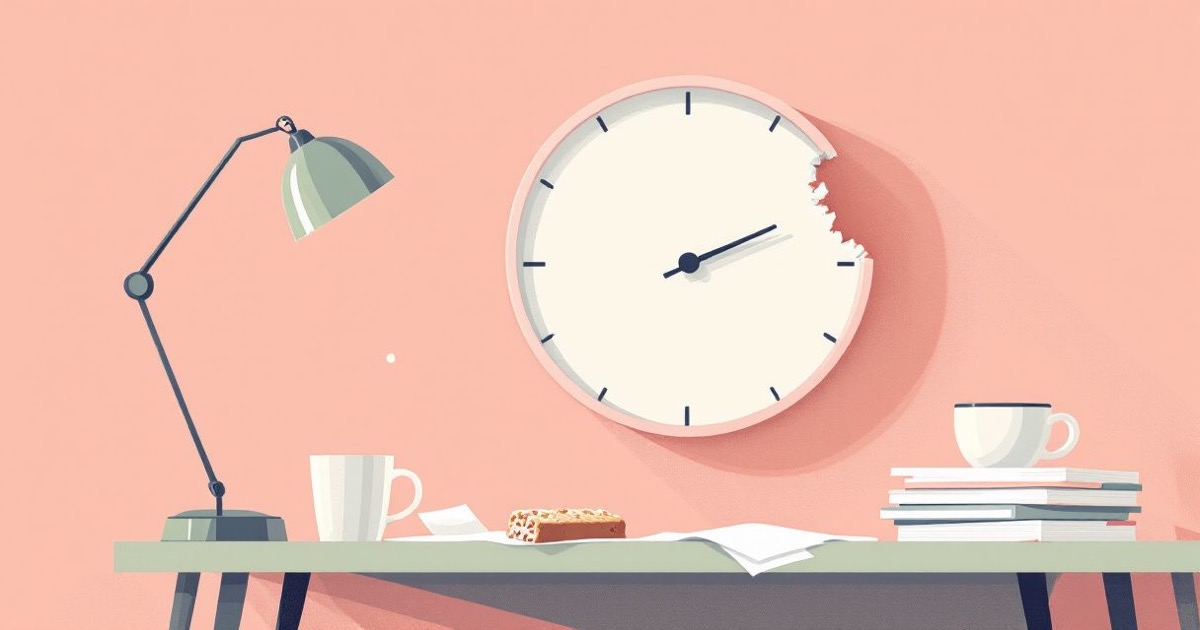
Here is the story everyone agrees on. Stress arrives, it turns into a feeling, the feeling walks you to the kitchen, and the kitchen hands you a biscuit. Every wellness article tells it. Every food app's onboarding quiz asks a version of "Do you eat when you're sad?" The American Psychological Association's Stress in America survey found 27% of adults say they eat to manage stress, and a third of those call it a habit. The advice writes itself: name the feeling. Ask whether you're hungry or just bored. Keep a mood journal. Learn the difference between emotional and physical hunger.
It is a satisfying story, and for a lot of people it appears to be wrong in an important way. In January 2026 the journal Stress and Health published a study by Christoph Bamberg, Jens Blechert and Julia Reichenberger, from the universities of Salzburg and Munich, that didn't ask people to remember how they eat under stress. It watched them do it. Sixty-four people were pinged on their phones six times a day, every day, for four weeks — about 168 check-ins each — and asked, each time, what stressors were present, how they felt, and whether they had snacked. General stressors — conflict, money worries, health, work problems — had no substantial effect on whether people snacked. Mood had none either: neither feeling bad nor feeling agitated predicted reaching for food. One thing did. Time pressure. When people reported being rushed, the odds that they'd snacked went up by about a third — from 28% of check-ins to 33% — and, tellingly, they ate smaller amounts. The authors' reading: this looks like "convenience- or necessity-driven adjustment rather than an affect-driven reaction." Not feelings. Logistics.
What the stress-eating research actually says (it's smaller than you think)
The emotional-eating story isn't invented; it's inflated. Greeno and Wing pointed out in 1994 that stress pushes eating in both directions, and the literature has never moved off that: roughly 35–40% of people eat more when stressed, and the rest eat less or don't change. Averaged across everyone, the effect is small. The largest meta-analysis to date, Hill and colleagues in Health Psychology Review (2022), pooled 54 studies and 119,820 adults and found stress associated with slightly more unhealthy food (Hedges' g = 0.116) and slightly less healthy food (g = −0.111). Those are real effects, and they are tiny — the statistical equivalent of a nudge, not a shove.
"Stress" in those studies is also a bucket, and the bucket contains wildly different things: a fight with your partner, a tax bill, a deadline at 5 p.m., a sick parent. The 2026 study's contribution was to empty the bucket onto the table and check each item separately. Only the deadline was doing anything to snacking. Which points to a mechanism that has nothing to do with your inner life: on a rushed day you skip or shrink a proper lunch (quantity goes down — the study saw exactly that), and then you graze on whatever is within arm's reach (snacking odds go up). The chocolate at 4 p.m. isn't about your childhood. It's about the meeting that ran over lunch.
Why the emotional-eating story sticks anyway
Three reasons. First, it's a better story: feelings are interesting and calendars are not, and a snack that reveals something about you is more compelling than a snack that reveals something about your Tuesday. Second, it's oddly absolving — if the trigger is deep, it's not really your fault, and it's also not really fixable, which lets everyone off the hook. Third, and most important, it's what memory hands you when a questionnaire asks. Retrospective surveys — "do you eat more when stressed?" — reliably get yes, because we remember the feeling that accompanied the snack far better than the schedule that caused it. Experience sampling, which asks in the moment, keeps finding that what you were actually doing was rushing. The gap between those two kinds of study is the gap between the story and the data.
If the trigger is time, the fix changes completely
You cannot journal your way out of a calendar. "Sit with the feeling" is decent advice for sadness and useless advice for a 12:30 that got moved to 1:15 and ran until 2. If time pressure is the trigger, the interventions become unglamorous and logistical, which is good news, because logistical problems are the ones that respond to being fixed.
- Protect lunch like a meeting. A twenty-minute block that other people can see on your calendar and cannot book over. The study's people who were rushed ate less at meals and more between them; a real lunch removes the gap the snacks fill.
- Decide what's within reach. Time-pressure snacking is by definition whatever is closest. You don't need willpower; you need the closest thing to be the thing you'd choose anyway.
- Build a rushed-day default. One meal you can eat in six minutes without deciding anything — the same one every time. Repetition is a feature here, not a failure of imagination.
- Eat before the crunch, not after it. If you know the afternoon is back-to-back, front-load. Post-crunch eating is where the largest, least-planned snacks live.
- Find your pattern days. Most people's time pressure is not random; it's Tuesdays, or the last three days of the month, or every day a particular recurring meeting sits at noon.
That last item is the crux, and it's where most people get stuck, because you can't see a pattern you haven't recorded — and the very condition that produces the snack is the one that kills the food log. Nobody who is twelve minutes late for a call opens an app and scrolls through forty database entries for "almonds, raw, 1 oz." So the record has a hole precisely where the answer is. It's the same mechanism behind why people quit tracking apps in general: the friction is highest exactly when the data would be most useful.
Log the 4 p.m. snack in less time than it takes to eat it
VoiceLog is built for the rushed moment: say one sentence — "handful of almonds and a flat white, rushed between calls" — and it files the calories, the time and your note. No database search, no barcode, no account; transcription happens on your iPhone. A week of three-second entries is enough to see whether your snacks track your feelings or your calendar. Free to start.
Get VoiceLogA one-week experiment (no feelings journal required)
- For seven days, log every snack the moment it happens — one sentence, plus a two-word context tag: rushed, bored, sad, social, hungry. Log meals too, with times; skipped or late lunches are the data.
- Don't change anything else. This is a measurement week, not a diet week.
- At the end, look at three things: how long the gap was before each snack, whether snack days were also short-lunch days, and which tag shows up most.
- If you've connected your log to an AI assistant over MCP, just ask it: "On which days did I snack most, and what did lunch look like on those days?"
If the study's finding holds for you, the answer will be boring and useful: rushed dominates, snack days are short-lunch days, and the fix is on the calendar, not in the journal. If instead sad and bored dominate and the gaps before snacks are short, then you have real evidence that emotional eating is your mechanism, and the emotional-eating toolkit — which is genuinely good for the people it fits — is the right one. Either way you stop guessing, which is the only thing a week of data can promise.
Changes in snacking behaviour are more strongly linked to specific situational constraints, such as time pressure, than to momentary emotional fluctuations.
The uncomfortable summary
The emotional-eating story asks you to understand yourself better. The time-pressure story asks you to book a lunch. One of those is more interesting, and the other one is more likely to work. If your snacking has a pattern, the pattern is probably in your week rather than in your psyche — and the only way to know which is to write down what actually happened, at the moment it happened, on the days when you had the least time to do it.
Find out whether it's your feelings or your Tuesdays
Speak one sentence per snack and meal; VoiceLog does the rest on your iPhone, privately. After a week, ask it — or Claude and ChatGPT via MCP — when you snack and what lunch looked like that day. Free on the App Store.
Get VoiceLogStress eating and time pressure: frequently asked questions
Why do I snack when I'm stressed?
It may not be the stress itself. A 2026 experience-sampling study in Stress and Health found that general stressors and negative mood had no substantial effect on snacking, but time pressure did — the odds of snacking rose by about a third on rushed occasions, while the amount eaten went down. The likely mechanism is logistical: rushed days shrink or skip proper meals, and grazing on whatever is nearby fills the gap.
What is the difference between stress eating and emotional eating?
Emotional eating means eating in response to a feeling — sadness, anxiety, boredom — rather than hunger. Stress eating is often used as a synonym, but stress is a mix of very different things (conflict, money, deadlines), and when researchers separate them, the deadline-type stressor of time pressure predicts snacking while the emotional component often does not. For many people, what feels like emotional eating is convenience eating under time pressure.
Does stress make you eat more or less?
Both, depending on the person. Since Greeno and Wing's 1994 review, studies have consistently found that roughly 35–40% of people eat more under stress and the rest eat less or the same. The largest meta-analysis (Hill et al., 2022; 54 studies, nearly 120,000 adults) found only small average effects: slightly more unhealthy food and slightly less healthy food.
How do I stop snacking when I'm busy?
Treat it as a scheduling problem. Block a protected twenty-minute lunch, make sure the food within arm's reach is the food you'd choose anyway, have one default rushed-day meal you can eat without deciding anything, eat before a known crunch rather than after it, and log snacks with a quick context tag for a week to find which days and which gaps drive them.
Is emotional eating real?
Yes. It is well documented in people who score high on emotional-eating measures and it matters clinically in binge eating. The point of the recent research is not that emotional eating doesn't exist, but that it is over-assigned: for the average busy adult, momentary emotions predict snacking far less than situational constraints like time pressure do, so it should not be the default assumption.