Why Most People Quit Calorie Counting
The classic calorie counter app workflow looks like this: open the app, tap "add food," type "chicken salad," scroll past forty near-identical database entries, pick one that looks close, guess whether your bowl is 1 serving or 1.5, then repeat for the latte you had with it. That's two to three minutes per meal — six to ten minutes a day, every day, forever.
Nutrition research consistently finds that self-monitoring works — people who log their food more consistently lose more weight — but also that adherence collapses within weeks for most users. The problem isn't motivation. It's friction. Every extra tap is a small tax, and small taxes compound until one skipped dinner becomes a skipped week.
- Database search punishes home-cooked and mixed meals the hardest
- Serving-size math turns every entry into a micro-decision
- Logging after the fact (at night, from memory) is when people give up
- Perfectionism creeps in: if you can't log it exactly, you don't log it at all
What Is a Voice Calorie Tracker?
A voice calorie tracker lets you log calories by voice: you describe what you ate in plain language, and the app does the rest — parsing the foods, estimating portions, and calculating calories and macros. No search box, no barcode, no dropdown menus.
With VoiceLog, you tap the mic and say something like:
"I had a chicken salad and an oat latte, ran 5K, and spent $14 on lunch."
From that one sentence, VoiceLog files a meal (with calories, protein, carbs, and fat estimated), a workout, and an expense — each in the right place. The whole interaction takes about five seconds. You talk to it the way you'd text a friend, not the way you'd fill out a form.
How Voice Logging Works in VoiceLog
1. Speak your meal
Tap the mic and describe what you ate. You can be casual ("two eggs and toast") or specific ("two fried eggs, one slice of sourdough with butter"). More detail means tighter estimates, but casual works fine for everyday consistency.
2. On-device transcription
Your speech is transcribed directly on your iPhone. The audio never leaves your device — only the finished text is saved, and it's only synced if you choose. For something as personal as everything you eat, that privacy model matters.
3. AI estimates calories and macros
VoiceLog interprets the transcript and estimates calories, protein, carbs, fat, and sugar for the meal. If you also mentioned a run, a purchase, or a to-do, each of those gets filed as its own entry automatically. (If macros are your main focus, see our guide to tracking protein and macros by voice.)
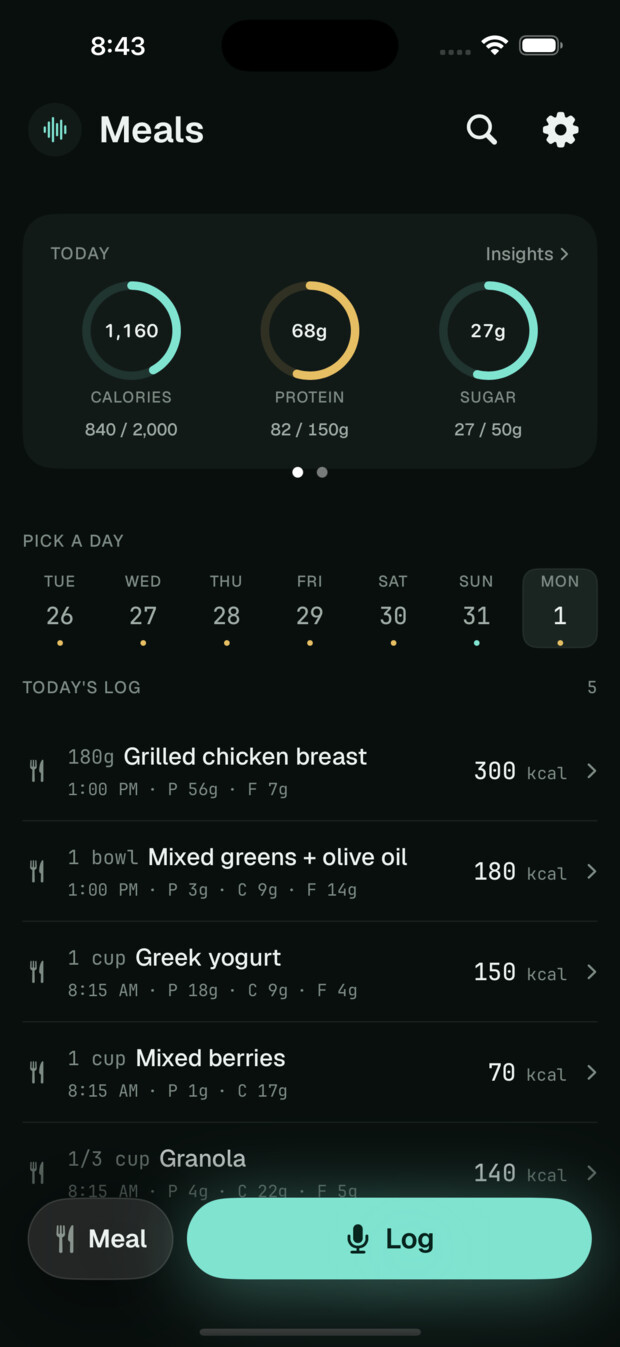
4. Your day updates at a glance
The Home screen shows a daily snapshot: calories eaten, your deficit, protein, steps, and spending — plus streaks that reward simply showing up. You always know where the day stands without opening a report.
Voice vs. Database Logging: The Real Difference Is Consistency
| Step | Database app | Voice logging |
|---|---|---|
| Time per meal | 1–3 minutes | ~5 seconds |
| Mixed / home-cooked meals | Search each ingredient | Describe the plate once |
| Precision | Exact if the entry is right (often it isn't) | Good estimate, every time |
| Adherence after week 4 | Drops off for most users | Low friction keeps the habit alive |
Here's the uncomfortable truth about "precise" database logging: a meal you don't log counts as zero. A rough estimate you actually record beats a perfect entry you never make. If your goal is a rough daily calorie picture you can act on — a deficit for weight loss, a surplus for building muscle — a consistent 90%-accurate log wins over a sporadic 99%-accurate one. If you're coming from a database-first app and feeling burned out, we wrote a full comparison in our MyFitnessPal alternative guide.
Beyond Calories: One Sentence Logs Your Whole Day
Because VoiceLog parses natural language rather than matching database entries, it isn't limited to food. The same sentence can carry:
- Meals — calories, protein, carbs, fat, and sugar, estimated automatically
- Workouts — runs, lifts, sets, reps, and calories burned
- Expenses — amounts and categories, with a daily under-budget streak (more in our voice expense tracking guide)
- To-dos — captured the moment you think of them
- Journal — a quick note on how the day went
Pro subscribers can also snap a photo of a meal and have it estimated, scan receipts, and connect AI assistants like Claude or ChatGPT to ask questions about their logs — for example, "what was my average protein last week?" (See how MCP connects your logs to your AI assistant.)
Tips for Better Voice Estimates
- Name quantities when you know them. "Two slices of pepperoni pizza" beats "some pizza."
- Mention cooking method for calorie-dense prep. Fried vs. grilled changes the estimate meaningfully.
- Log right after eating. Five seconds in the moment beats reconstructing the day at 10pm.
- Don't chase perfection. If the estimate looks off, adjust it — but consistency matters more than any single meal.
- Batch your sentence. Meal, workout, and spending can all go in one recording.
Honest Limitations
Voice logging is a trade-off, and it's worth being clear about it. Calorie and macro numbers from a spoken description are estimates — good ones, but not lab measurements, and a database entry for a packaged food with a printed label can be more exact. VoiceLog works best in English today. It's iOS-only (iPhone, iOS 18 or later), so there's no Android version. And speaking your lunch out loud isn't always practical in a quiet office — though you can type a quick text log when talking isn't an option. If you need gram-level precision for a medical protocol or a bodybuilding prep peak week, a scale and a database remain the right tools; for everyone else, the consistency win usually dominates.
Frequently Asked Questions
How accurate is voice calorie tracking?
Accurate enough to manage a daily calorie target. Estimates for common foods and portions typically land close to database values, and you can edit any entry. The bigger accuracy lever is consistency: research shows people who log regularly get better outcomes than people who log precisely but rarely.
Does VoiceLog record or upload my voice?
Transcription runs on your device, so your audio never leaves your phone. Only the finished text is saved, and it's only synced across devices if you turn sync on.
Do I need a subscription to log calories by voice?
No — voice meal logging with calorie and macro estimates works in the free app. VoiceLog Pro ($12.99/month or $99.99/year, with a 7-day free trial) adds meal-photo and receipt scanning, longer recordings, AI assistant connections, and cross-device sync.
Can I log food without speaking?
Yes. You can type a quick text description instead of talking, and Pro users can snap a photo of a meal for an automatic estimate.
Does it track anything besides food?
Yes — workouts, expenses, to-dos, and journal entries all come from the same voice note, and the Home screen combines calories, deficit, protein, steps, and spending into one daily snapshot.
The Bottom Line
Calorie tracking works when you actually do it. The apps that fail people don't fail on features — they fail on friction. If typing into a food database has burned you out before, try the five-second version: say what you ate, and let the app do the filing.