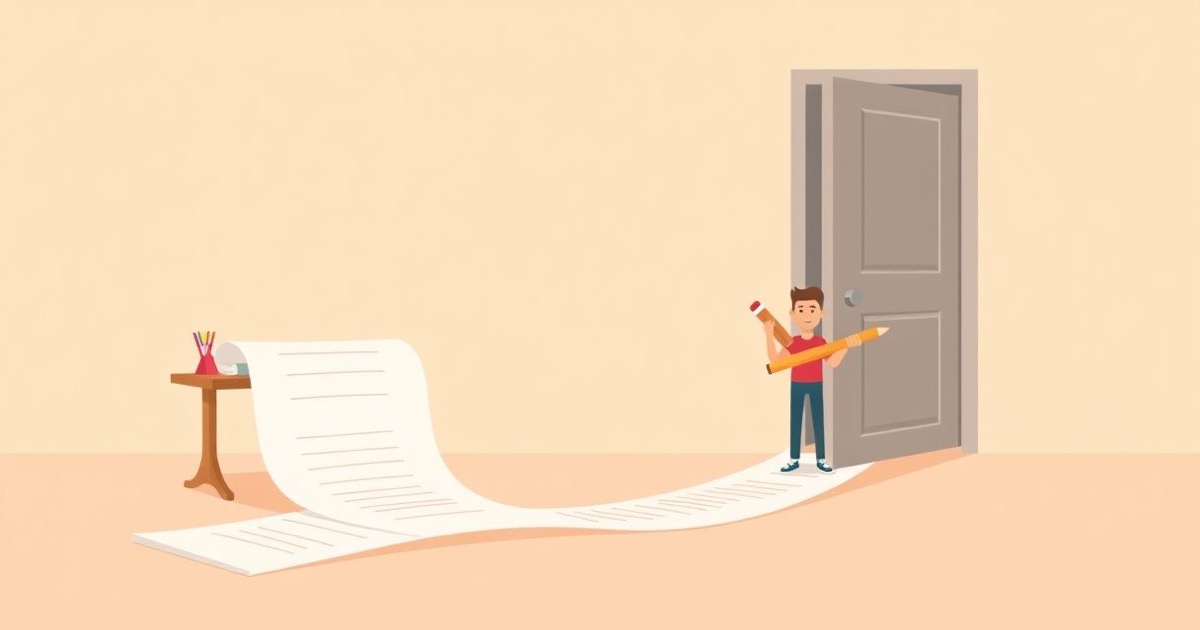
Somewhere on your phone right now lives a to-do list containing the item "dentist??" It has been there since March. You don't remember which question the second question mark was answering. Below it: "email Mark back" (Mark has since changed jobs), "look into Roth thing," and "CANCEL TRIAL" in a capitalization that suggests it was already too late when you wrote it. This is not a personal failing. This is simply what to-do lists do. They are where intentions go to develop a rich interior life and never come out.
The numbers back up the vibe. When the productivity company iDoneThis analyzed usage data across its users, it found that 41% of to-do items were never completed. Not delayed — never. And the punchline's punchline: of the tasks people did complete each day, only 15% had started out on the list at all. Read that again. Your to-do list is failing in both directions simultaneously. It doesn't predict what you'll do, and it doesn't cause what it predicts. As instruments go, it's a barometer that's wrong about yesterday's weather.
Your brain treats the list as a threat, then eats the snacks
The first problem is what psychologists call completion bias: your brain gets a dopamine hit from checking things off, so it steers you toward whatever is checkable fastest. "Reply to Slack" gets done eleven times a day. "Draft the proposal that determines my career trajectory" gets moved to tomorrow, where it has now lived for six weeks. Harvard Business School researchers found that workers who loaded up on easy tasks felt more productive that day and performed measurably worse over time. The list doesn't just permit this — it engineers it. It presents "buy stamps" and "figure out what I'm doing with my life" in the same font, same checkbox, same visual weight, like a menu where the fries and the mortgage cost the same.
Meanwhile, the big items you keep not doing don't politely wait. Unfinished tasks generate what's known as the Zeigarnik effect — your brain keeps intrusive background tabs open for everything incomplete. That's why "renew passport" pops into your head at 11:40pm, in the shower, and during your one relaxing activity, but never — not once — when you are physically capable of renewing a passport. The elegant part, per research by Masicampo and Baumeister: the nagging stops not when you finish the task, but when you write down a specific plan for it. Your brain doesn't need the thing done. It needs to believe the thing is handled. Which brings us to the tragedy: a vague list item isn't a plan, so "dentist??" delivers zero relief while still cluttering the list. Worst of both worlds. The item nags AND rots.
The list isn't too long. Your working memory is too short
Cognitive scientists put usable working memory at around four chunks of information. Four. Your to-do list has thirty-one items, which means twenty-seven of them functionally do not exist to your brain at any given moment. Scrolling the list doesn't help — every glance at all thirty-one items triggers micro task-switching, and switching costs are brutal: research on multitasking puts the productivity loss at up to 40%. The thirty-one-item list isn't a productivity tool at that point. It's a museum of guilt with a scroll bar.
So people quit. Not dramatically — nobody deletes the app while maintaining eye contact. They just… drift. The same abandonment curve shows up in every tracking category — we wrote about the pattern in why you quit tracking apps — and to-do apps might have it worst, because a stale to-do list actively punishes you for returning. Open a food log after a week away and it's just empty. Open a to-do list after a week away and forty items scream at you in chronological order of your failures. Of course you don't go back. Nobody returns voluntarily to the yelling museum.
The real killer: capture friction
Here's the step where the whole system actually dies, and it's earlier than you think. It's not execution. It's capture. A task occurs to you while you're driving, cooking, walking the dog, mid-meeting, holding a baby, holding a different to-do list. To record it you must: get the phone, unlock the phone, dodge the notification about someone's birthday, find the app, tap new, type the thing, categorize the thing, feel briefly mortal, lock the phone. That's ten steps. Behavioral science is unambiguous about what ten steps does to a habit: it murders it. So the task doesn't get captured. It goes back into the Zeigarnik rotation, resurfacing at 2am like a ghost with unfinished paperwork.
This is why the classic brain dump — sit down, empty every open loop in your head onto paper — feels so absurdly good. Therapists recommend it. Productivity Twitter rediscovers it quarterly. It works because it's the one moment capture has zero friction: no categorizing, no app navigation, just pure extraction. The pile in your head feels infinite; written down, it's usually twenty minutes long. The problem is that the classic brain dump is an event. You do it on a Sunday, feel like a new person, and by Wednesday the head-pile is back, because tasks don't arrive on Sundays. They arrive constantly, in exactly the moments your hands are busiest.
The brain dump that keeps up with your brain
VoiceLog turns capture into one spoken sentence. Say "remind me to cancel the trial before Friday" or "todo: book dentist" — while driving, cooking, or mid-dog-walk — and it's filed as a todo, on-device, no typing, no app-spelunking. It catches expenses, meals, and workouts the same way, so the 2am ghost of unfinished paperwork finally has nowhere to haunt. Free to try.
Get VoiceLogWhat actually works (according to the same research)
The fix isn't a better list app with more colors. The research points to four changes, none of which involve a Kanban board:
- Capture instantly, sort never (or later). The moment a task occurs to you is the only moment it's free to record. Every second of friction between thought and capture is where tasks escape. Get it out of your head in one step and let sorting be a separate, optional activity.
- Make plans, not entries. "Dentist??" nags forever; "call dentist Tuesday at lunch" releases the mental tab, per Masicampo and Baumeister. When you capture, capture the when.
- Pick three for today. Working memory holds about four chunks — a daily list of three real tasks fits in your actual brain. The other twenty-eight live in the archive, where they can't yell at you.
- Let the list forget. A to-do item you've skipped for three weeks isn't a task, it's a small recurring insult. Archive it guilt-free. If it matters, it'll come back — probably at 2am, at which point you can capture it properly.
Notice the theme: every fix reduces the ceremony between your brain and the record. This is the same principle that's quietly winning across all self-tracking — voice journaling over the beautiful notebook you never open, spoken logs over the seventeen-field form. The best system isn't the most organized one. It's the one that's still running in November.
A word about the streak of shame
One more mercy, because to-do apps borrowed the worst idea from habit apps: the completion streak. If your list app makes you feel like missing a day broke something, know that the psychology here is well-studied — a broken streak predicts nothing about your long-term success, and the "what the hell" spiral it triggers is more damaging than the miss itself. A to-do system should be a valet, not a parole officer. If yours makes you feel worse than having no system, that's not a moral failure to push through. That's a design failure to walk away from.
The list was never the point
Here's the reframe that makes the 41% statistic stop hurting: a to-do list was never supposed to be a contract. It's an external memory — a place for open loops to live so your head doesn't have to hold them. Judged as a contract, your list is in flagrant breach. Judged as memory, it only has one job: be effortless to write to. The moment capture costs nothing, the whole downstream system starts working — the nagging stops, the three-item daily list becomes possible, and "dentist??" finally becomes "dentist, Tuesday, called, done." You will still not know what the second question mark meant. Some mysteries we keep.
Say it once. It's captured. Go live your life.
VoiceLog is the external memory that costs nothing to write to: speak one sentence and your todo, expense, meal, or workout is logged — transcribed on your iPhone, filed automatically, done before you'd have found the right app. Ask Claude or ChatGPT about your own logs later via MCP. Your brain has better things to hold.
Get VoiceLogTo-do lists and the brain: frequently asked questions
Why do I never finish my to-do list?
Because to-do lists work against three features of your brain: completion bias steers you toward small checkable tasks instead of important ones; working memory only holds about four items, so long lists are invisible past the top; and vague entries ("dentist??") create ongoing mental nagging — the Zeigarnik effect — without ever becoming actionable. Data from iDoneThis found 41% of list items are never completed at all, so an unfinished list is the norm, not a personal failure.
What is the brain dump method?
A brain dump is emptying every task, worry, and open loop in your head into an external record without sorting or judging it. Research on the Zeigarnik effect shows this quiets intrusive task-thoughts: your brain stops nagging once it believes an item is safely captured, even before it's done. The classic version is a weekly pen-and-paper session; the modern version is continuous capture — recording tasks by voice the instant they occur to you.
How many items should be on a daily to-do list?
Around three. Cognitive research puts usable working memory at roughly four chunks, so a daily list of one to three meaningful tasks stays mentally visible all day, while a thirty-item list functionally disappears. Keep a separate master archive for everything else and promote at most three items each morning.
Do to-do lists actually work?
As contracts, no — only 15% of tasks people complete in a day started on their list. As external memory, yes: writing tasks down with a specific plan measurably reduces intrusive thoughts and frees working memory (Masicampo & Baumeister, 2011). The value is in reliable, frictionless capture, not in the checkbox. Judge a to-do system by how easy it is to add to, not by its completion percentage.
What is the Zeigarnik effect?
The Zeigarnik effect is the psychological tendency for unfinished tasks to stay mentally active — popping into your head repeatedly — while completed tasks are quickly forgotten. Follow-up research showed the intrusive thoughts stop once you make a concrete plan for the task, not only when you finish it. That's the scientific case for capturing tasks immediately and specifically: it converts an open loop into a closed one your brain can release.